10 Backyard Pool Landscaping Ideas That Turn Your Yard Into a Retreat
If you’ve ever stood at the edge of your pool and thought “this could look so much better,” you’re not alone. A pool by itself is just water in a hole in the ground. What actually makes a backyard feel like a resort — the kind of space where you linger with a cup of coffee in the morning or a glass of wine at sunset — is the landscaping around it.
In my experience working with homeowners on outdoor spaces, the pool itself is rarely the problem. It’s everything surrounding it: bare concrete, patchy grass, a fence that feels too close, or planting that was never designed to work with the shape of the yard. A mistake many homeowners make is investing heavily in the pool installation and then treating the landscaping as an afterthought, when really the landscaping is what determines whether the space feels finished or half-done.
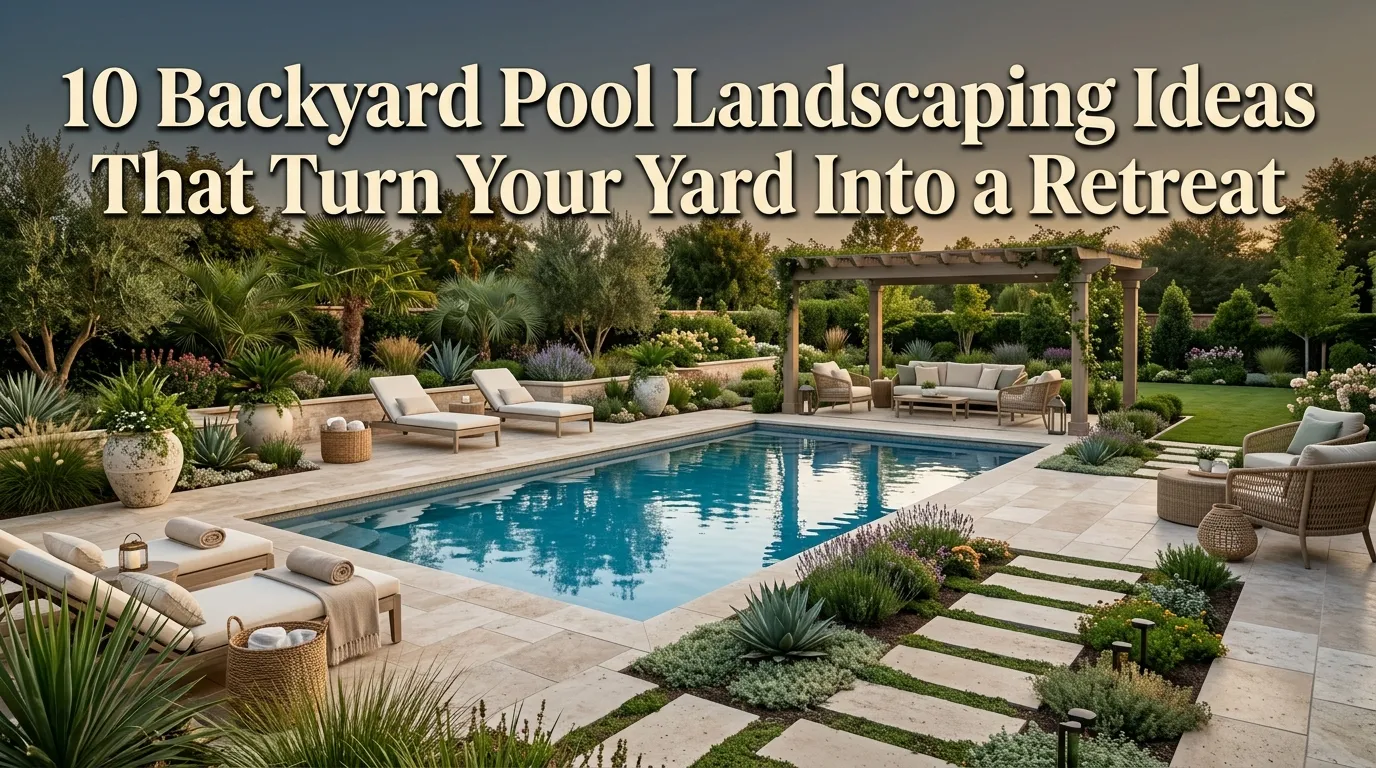
This guide walks through ten backyard pool landscaping ideas that consistently work, whether you’re dealing with a small suburban lot or a sprawling backyard with room to spare. I’ve noticed that the most successful pool areas combine a few key elements — layered greenery, defined pathways, comfortable lounge zones, and thoughtful lighting — rather than relying on one dramatic feature to do all the work.
You don’t need to tackle everything on this list at once. Start with the ideas that solve your biggest frustration first, whether that’s privacy, shade, maintenance, or simply making the space feel more intentional. By the end of this article, you’ll have a clear picture of which direction fits your yard, your climate, and your lifestyle.
Table of Contents
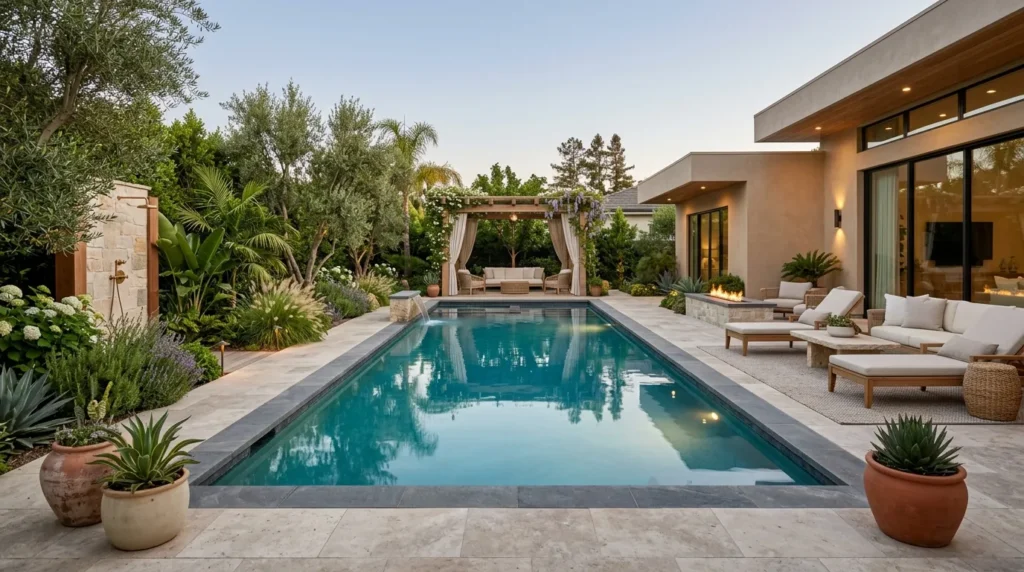
- Tropical Plant Borders — Soften hard pool edges with lush, layered greenery.
- Natural Stone Pathways — Create defined, non-slip walkways that guide movement around the pool.
- Poolside Lounge Zones — Design dedicated seating areas that extend the pool’s living space.
- Layered Greenery Design — Build depth and visual interest using varied plant heights.
- Water Feature Accents — Add movement and sound with fountains, spillways, or bubblers.
- Desert Modern Landscaping — Pair drought-tolerant plants with clean architectural lines.
- Privacy Hedge Screens — Block sightlines from neighbors without feeling boxed in.
- Ambient Lighting Design — Extend pool use into the evening with layered lighting.
- Outdoor Shade Structures — Give swimmers and sunbathers relief from direct sun.
- Low Maintenance Ground Cover — Replace grass and mulch with easier, longer-lasting options.
1. Tropical Plant Borders
Quick Benefits
- Softens hard concrete and stone edges
- Creates a resort-style atmosphere
- Works well in humid and warm climates
- Adds privacy without solid structures
- Attracts a lush, vacation-like mood
Why It Works
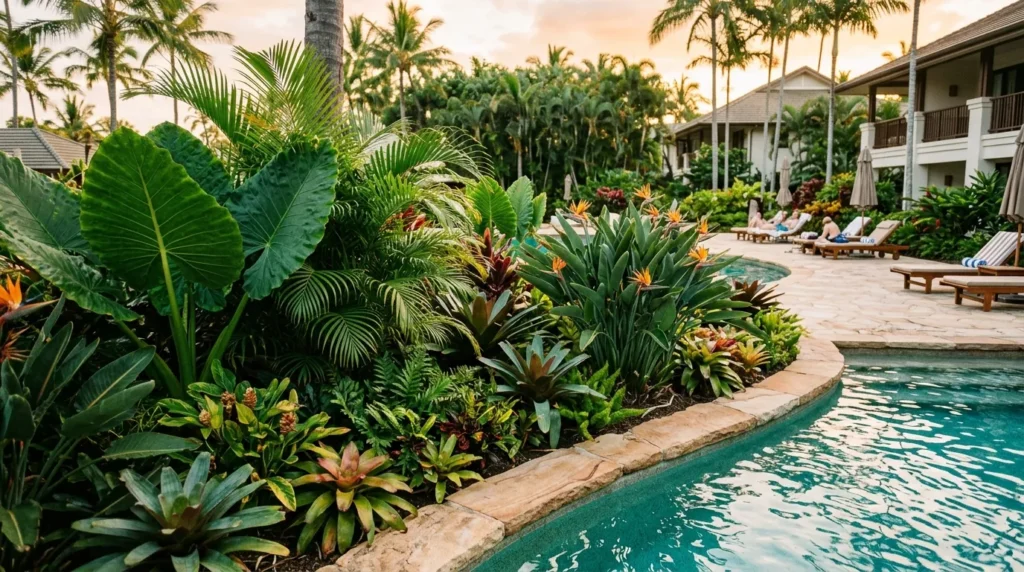
There’s a reason tropical planting shows up in nearly every high-end resort pool photo. Broad-leafed plants like palms, elephant ears, and bird of paradise soften the hard lines of concrete decking in a way that flat lawn simply can’t. In my experience, the biggest visual jump in a pool renovation often comes not from the pool itself, but from what’s planted directly around its perimeter. Tropical borders create an immediate sense of escape, even in a backyard that’s only a few hundred square feet. The layered leaf shapes also do practical work, casting dappled shade and breaking up long sightlines so the yard feels more enclosed and intentional rather than exposed.
How To Style It
Plant in clusters of three to five rather than single specimens spaced evenly apart — irregular groupings read as natural, while evenly spaced planting reads as landscaped and stiff. Mix leaf textures: pair broad tropical leaves with something finer, like ornamental grass, to keep the eye moving. If you’re not in a naturally tropical climate, look for cold-hardy substitutes such as canna lilies, hostas, or hardy hibiscus that mimic the look. Keep planting beds at least 18–24 inches back from the pool edge to avoid excess leaf litter in the water, and choose a mulch color that complements your deck material rather than competing with it.
2. Natural Stone Pathways
Quick Benefits
- Reduces slippery grass and mud near the pool
- Adds texture and visual contrast
- Guides foot traffic intentionally
- Increases property value and curb appeal
- Pairs well with almost any design style
Why It Works
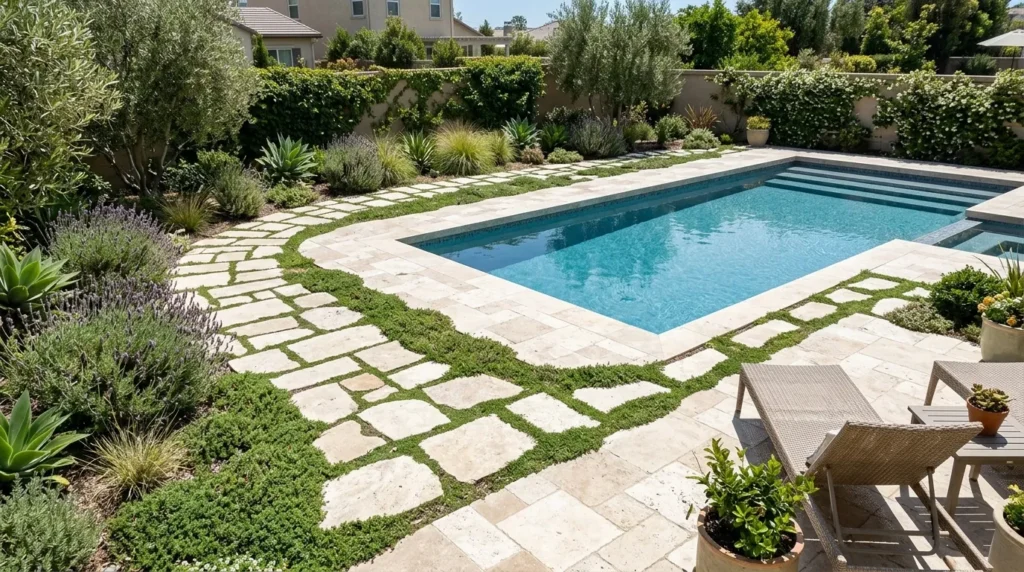
A pool without a defined path around it often ends up with worn, muddy tracks in the grass within the first summer. Natural stone — flagstone, travertine, or textured concrete pavers — solves that problem while adding a layer of intentional design. That’s why many designers recommend treating the pathway as its own design element rather than an afterthought poured in as leftover budget. Stone also holds up better than mulch or gravel near a pool, since it doesn’t wash into the water or track indoors on wet feet. The texture contrast between smooth pool coping and rougher natural stone creates visual depth that a single flat material can’t achieve on its own.
How To Style It
Choose a stone that stays cool underfoot in direct sun — light-colored travertine is popular around pools for exactly this reason, since darker stone can get uncomfortably hot. Lay pathways in a slightly irregular, staggered pattern rather than a rigid grid for a more organic feel, and leave narrow planting gaps between stones for low groundcover like creeping thyme. Keep the primary path at least 36 inches wide so two people can pass comfortably. If budget is tight, a stone accent border around a poured concrete path gives much of the same visual payoff at a fraction of the cost.
3. Poolside Lounge Zones
Quick Benefits
- Extends usable living space outdoors
- Encourages longer time spent in the yard
- Creates distinct areas for sun and shade
- Improves flow between pool and house
- Makes the space feel like a true retreat
Why It Works
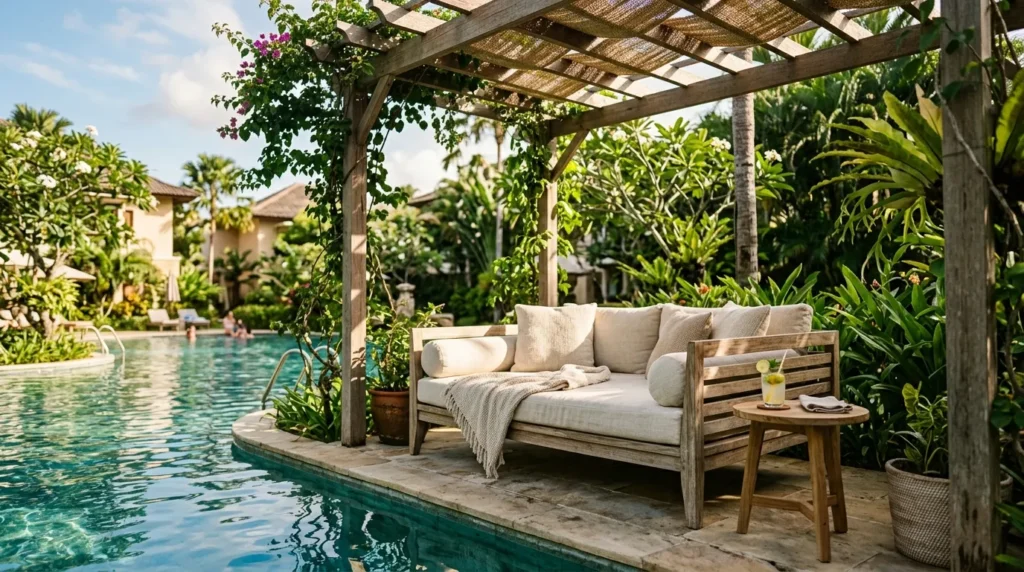
One simple trick I always suggest to homeowners who feel like their pool area is “just a pool” is to design at least one dedicated lounge zone that has nothing to do with swimming. A shaded seating nook, a daybed area, or a small conversation set with a side table turns the space from a single-purpose feature into a full outdoor room. I’ve seen this idea transform spaces more than almost any other change on this list, because it changes how people actually use the yard — not just for swimming, but for reading, working, or hosting friends who never get in the water at all.
How To Style It
Position lounge furniture so it has a clear view of the pool but isn’t directly in the splash zone — a few feet of buffer, ideally with a low planting bed or short wall, keeps furniture dry. Use weather-resistant materials like teak, powder-coated aluminum, or all-weather wicker rather than furniture meant for indoor use. Layer in a shade element (umbrella, pergola, or mature tree canopy) so the zone is usable during peak afternoon heat. A simple outdoor rug, even a synthetic all-weather one, does a lot to visually separate the lounge area from the surrounding deck.
4. Layered Greenery Design
Quick Benefits
- Adds depth without blocking sunlight on the pool
- Works in nearly any climate with the right plant choices
- Creates year-round visual interest
- Softens fences and walls
- Reduces the “empty yard” feeling
Why It Works
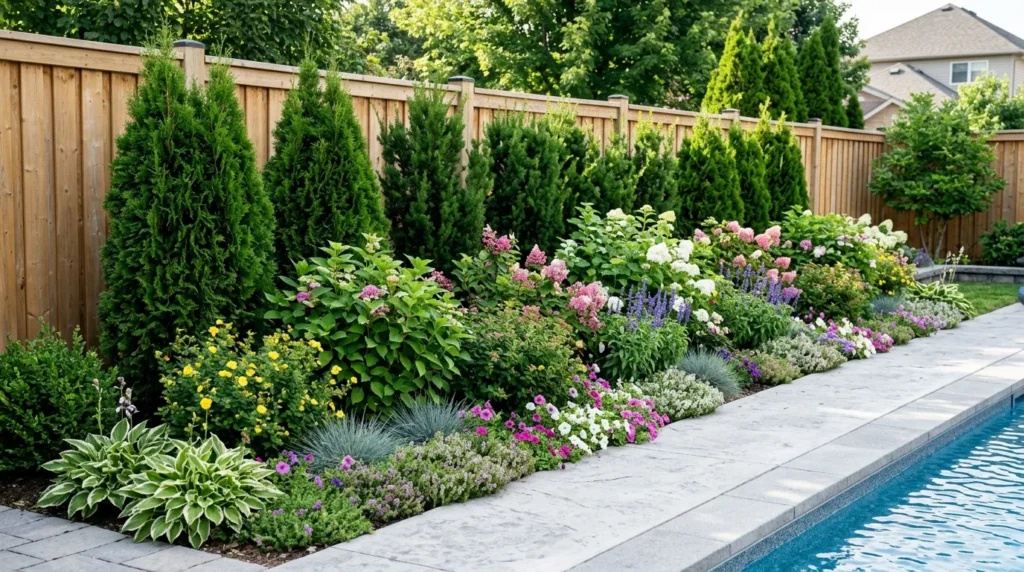
Layered greenery simply means planting at different heights — tall shrubs or small trees in the back, mid-height plants in the middle, and low groundcover or flowers in front. In my experience, this is the single most underused technique in backyard design. A single row of matching shrubs along a fence line looks flat and repetitive, while layered planting creates the kind of depth you’d see in a professionally designed garden. It also solves a practical problem specific to pools: you want privacy and greenery around the edges, but you don’t want tall plants shading the water itself or dropping debris directly into it.
How To Style It
Plan your layers in a rough triangle from the fence line toward the pool: taller plants (8–15 feet) at the back property line, mid-size shrubs (3–6 feet) in front of those, and low border plants (under 2 feet) closest to the hardscape. Choose at least one evergreen variety per layer so the bed doesn’t look bare in winter. Stagger bloom times across your flowering plants so something is always in color from spring through fall. Keep any layer within 10 feet of the pool trimmed and inspected regularly to minimize leaf and petal drop into the water.
5. Water Feature Accents
Quick Benefits
- Adds soothing sound to mask street noise
- Creates a focal point beyond the pool itself
- Increases the resort-style feel
- Works in both modern and traditional designs
- Can be scaled to fit small or large yards
Why It Works
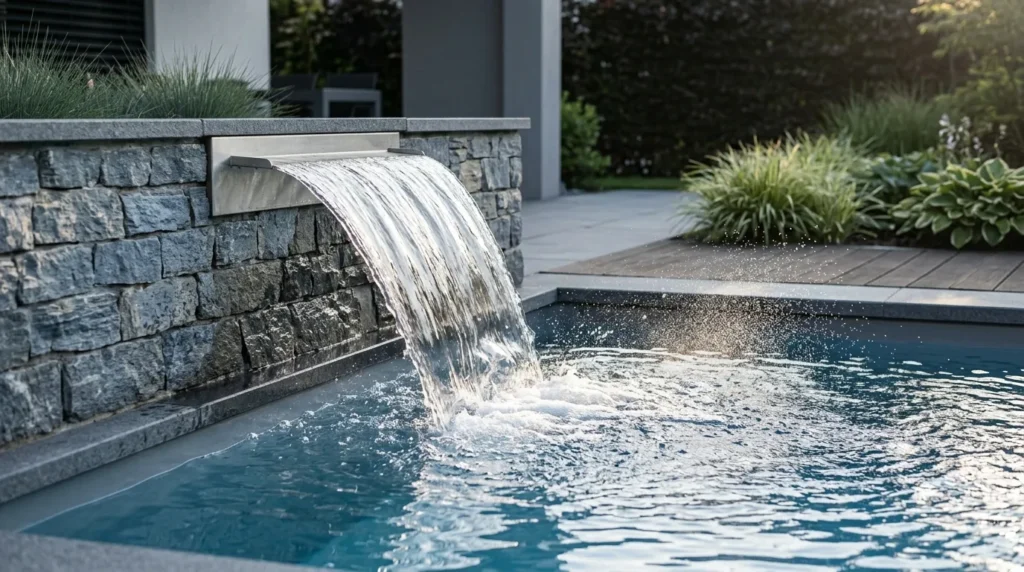
A pool is water, but it’s rarely moving water — and there’s a real psychological difference between still and moving water in a space. A spillway, sheer descent fountain, or small bubbler adds both sound and visual motion, which does a lot of quiet work in making a backyard feel calmer and more expensive-looking than it actually is. A mistake many homeowners make is assuming water features are only for large luxury pools, when in reality a single well-placed deck jet or scupper can transform a modest pool into something that feels custom-designed, often for a surprisingly modest cost.
How To Style It
If you’re adding a feature to an existing pool, deck jets and bubblers are typically the easiest retrofit since they don’t require major structural changes. For new builds or renovations, a raised spillway or sheer descent wall built into a raised planter or spa creates a strong visual anchor at one end of the pool. Keep the sound level in mind — a single feature is usually enough for a residential yard; too many at once can create an overwhelming, echoing effect rather than a calming one. Position water features where they’re visible from your main lounge area so you get the benefit even when you’re not in the pool.
6. Desert Modern Landscaping
Quick Benefits
- Dramatically reduces water usage
- Requires significantly less ongoing maintenance
- Pairs beautifully with modern pool designs
- Holds up well in hot, dry climates
- Creates a clean, architectural look
Why It Works
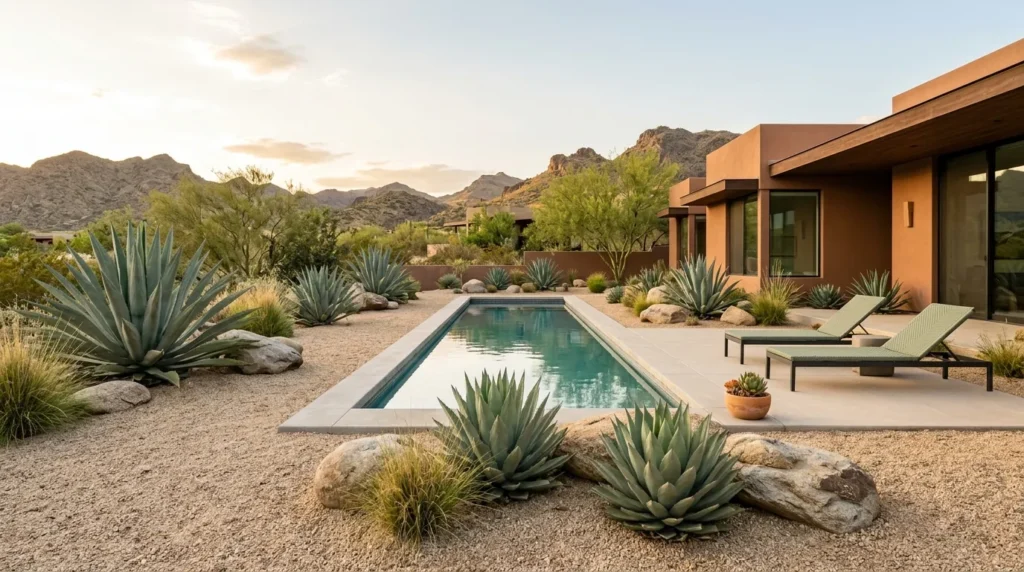
If you’re anything like me, you’ve watched a beautifully planted yard turn brown and patchy within a few dry summers because the planting plan never matched the climate. Desert modern landscaping flips that problem by working with drought-tolerant plants — agave, yucca, ornamental grasses, and succulents — paired with hardscape materials like decomposed granite, large-format pavers, and boulders. This style has become especially popular around pools because the clean geometric lines of the plants and the strong architectural forms complement a pool’s straight edges and modern coping in a way that soft, lush planting sometimes doesn’t.
How To Style It
Anchor beds with a few large architectural plants — agave or yucca work well — rather than many small ones, since the style relies on negative space as much as the plants themselves. Use decomposed granite or gravel in a neutral tone as ground cover instead of mulch, which tends to look out of place in this style. Add boulders or large stones in odd-numbered groupings for a natural, unforced arrangement. Keep irrigation minimal and targeted with drip lines rather than sprinklers, both for water savings and because overspray on gravel paths creates a muddy mess.
7. Privacy Hedge Screens
Quick Benefits
- Blocks direct sightlines from neighboring yards
- Reduces wind around the pool area
- Softer alternative to tall fencing
- Doubles as a natural sound buffer
- Improves year-round privacy with evergreens
Why It Works
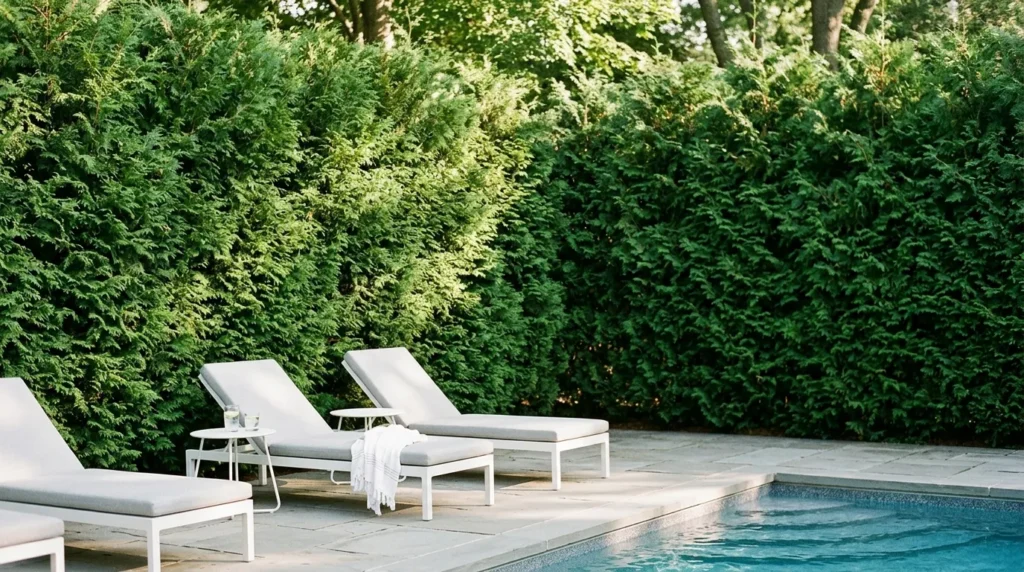
Nothing undermines the relaxed feeling of a backyard pool faster than knowing a neighbor’s second-story window looks straight down onto your lounge chairs. That’s why many designers recommend a privacy hedge as one of the first landscaping investments around a new or existing pool, even before more decorative planting goes in. Unlike a fence, a hedge softens as it grows and adds a natural backdrop to every other design element on this list. I’ve noticed that hedges also do quiet work reducing wind, which matters more than people expect — a breezy pool deck feels noticeably less comfortable than a sheltered one, even on a warm day.
How To Style It
Choose fast-growing evergreens like Emerald Green arborvitae, Leyland cypress, or clumping bamboo (with a root barrier) if you need privacy quickly, or slower-growing options like boxwood or holly if you’re willing to wait for a more refined, tailored look. Stagger plants in a slightly offset double row rather than a single straight line for denser coverage with fewer visible gaps. Leave enough space between the hedge and the pool deck for maintenance access — at least 3 feet is a reasonable minimum. Combine hedging with a single decorative tree at a corner to break up the uniformity of the green wall.
8. Ambient Lighting Design
Quick Benefits
- Extends pool use well into the evening
- Improves safety around steps and paths
- Highlights key landscaping features at night
- Adds a resort-style glow to the water
- Works with both LED and solar options
Why It Works
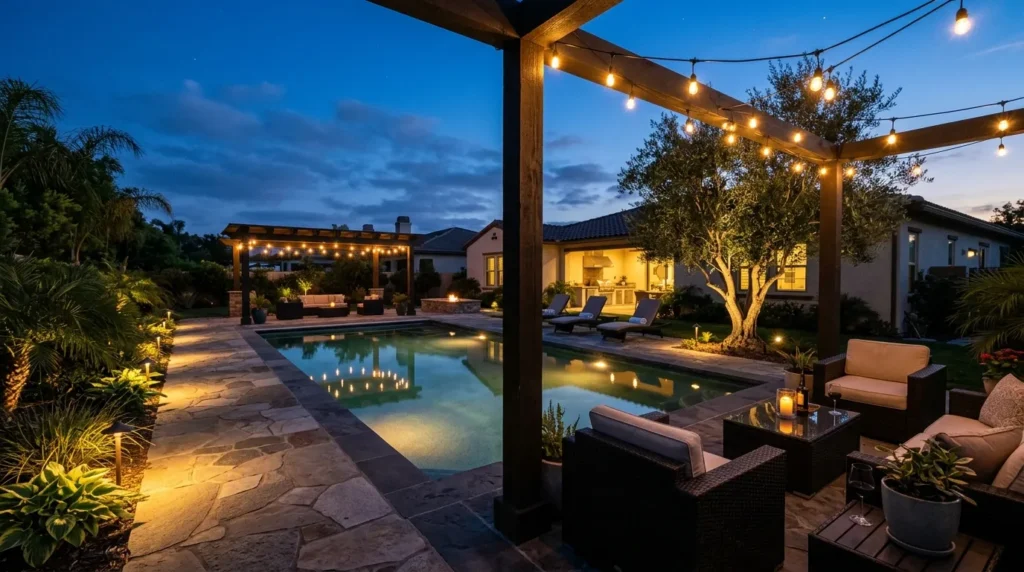
A pool area that looks great during the day and disappears into darkness at night is only working half the time it could be. Ambient lighting — path lights, uplighting on trees, and subtle pool-adjacent fixtures — solves that. In my experience, layered lighting (rather than one bright overhead source) is what separates a backyard that photographs like a magazine spread from one that just has “some lights.” Good lighting also does real safety work, illuminating steps, pathway edges, and pool boundaries so evening swims and gatherings feel secure rather than risky.
How To Style It
Layer three types of light: path lighting along walkways for safety, uplighting aimed at trees or architectural plants for drama, and soft ambient lighting (string lights, lanterns, or recessed deck lights) over lounge areas for warmth. Keep pool-adjacent fixtures low-voltage and rated for wet locations. Avoid a single bright floodlight, which flattens the space and creates harsh shadows; several smaller, warmer-toned fixtures almost always look better than one powerful one. Solar-powered path lights are a low-cost way to test a lighting layout before committing to hardwired fixtures.
9. Outdoor Shade Structures
Quick Benefits
- Provides relief from direct afternoon sun
- Protects furniture and decking from UV damage
- Creates a defined architectural focal point
- Extends comfortable use into hotter months
- Increases usable square footage of the yard
Why It Works
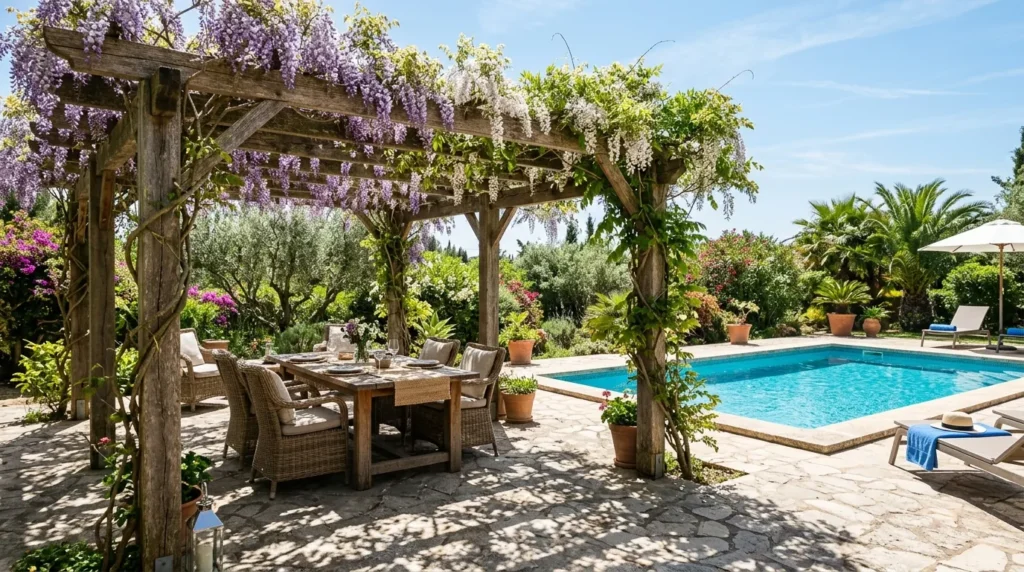
A backyard pool without any shade tends to get used in short bursts — a quick swim, then everyone retreats indoors once the sun gets too intense. A pergola, shade sail, or covered cabana changes that pattern entirely. One thing that works especially well is positioning a shade structure not directly over the pool, but over an adjacent lounge or dining area, so swimmers get sun while loungers get relief — giving the whole space more flexibility throughout the day. Shade structures also protect outdoor furniture, which otherwise fades and cracks quickly under constant UV exposure.
How To Style It
A pergola with an adjustable louvered roof gives the most flexibility, letting you dial in shade throughout the day, though a fixed pergola with climbing vines (like wisteria or climbing hydrangea) achieves a similar effect at a lower cost over time. Shade sails are a budget-friendly option for covering large areas quickly and work particularly well in modern or minimalist yards. Whatever structure you choose, position it to block the harshest afternoon sun angle for your specific yard orientation rather than centering it purely for symmetry — function should come before perfect visual balance here.
10. Low Maintenance Ground Cover
Quick Benefits
- Cuts down on regular mowing and edging
- Reduces grass clippings and debris near the pool
- Handles foot traffic better than traditional lawn
- Stays greener with less water in many cases
- Works well in both sun and partial shade
Why It Works
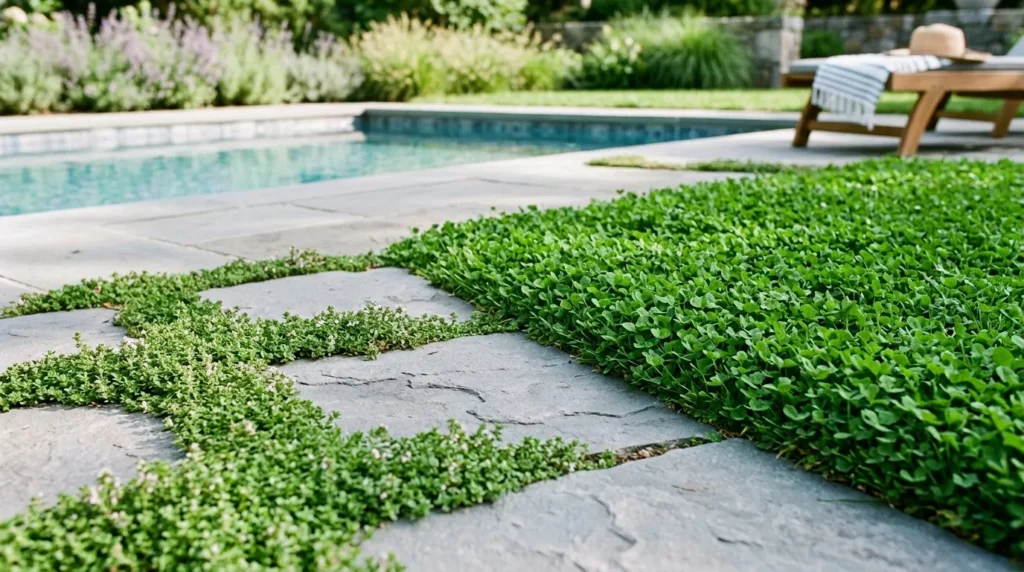
Traditional grass right up to the pool edge tends to cause more problems than people expect — clippings blow into the water, muddy patches form near high-traffic areas, and mowing close to the pool edge is genuinely annoying. Low maintenance ground covers like creeping thyme, clover lawn blends, or artificial turf solve most of these issues at once. A mistake many homeowners make is assuming their only options are grass or gravel; in reality, there’s a wide middle ground of ground covers that stay green, handle foot traffic, and require a fraction of the upkeep of a traditional lawn.
How To Style It
For sunny areas directly around the pool deck, consider a clover or fescue blend that stays low and requires less frequent mowing than standard turfgrass. For narrow strips between pavers or stone, creeping thyme or Irish moss fills gaps attractively and releases a pleasant scent underfoot. If low maintenance is the top priority, high-quality artificial turf has improved significantly in look and feel, and it eliminates clippings near the water entirely — though it’s worth budgeting for a permeable, well-drained installation so the area doesn’t retain heat or standing water after rain.
Frequently Asked Questions
What is the cheapest way to landscape around a pool?
Mulch beds combined with a few well-placed shrubs are typically the most budget-friendly starting point. Adding gravel or decomposed granite pathways instead of poured stone also cuts costs significantly. Focus your budget on one or two higher-impact areas, like a small lounge zone or a privacy hedge, rather than spreading it thin across the whole yard at once.
What plants are safe to plant near a pool?
Look for plants with minimal leaf, flower, or seed drop, since debris that falls into the pool increases cleaning and filtration work. Ornamental grasses, boxwood, agave, and many tropical foliage plants are popular choices. Avoid plants known for heavy pollen, thorns, or messy fruit drop directly at the pool’s edge.
How far should landscaping be from a pool?
A general guideline is keeping larger shrubs and trees at least 10 feet from the water’s edge to limit root intrusion and debris. Smaller plants and groundcover can sit closer, generally 18–24 inches from the coping, as long as they’re chosen for low leaf drop.
Do I need a professional landscaper for pool landscaping?
Not necessarily. Smaller projects like adding potted plants, path lighting, or a mulch bed are very manageable as DIY projects. Larger changes involving grading, irrigation systems, or structural features like pergolas often benefit from professional input, especially around drainage near the pool.
What is the best ground cover around a pool?
It depends on your climate and how much foot traffic the area gets. In warm climates, clover or fine fescue blends handle sun and moisture well. In shadier spots, creeping thyme or Irish moss works nicely between pavers. Artificial turf is a strong low-maintenance option regardless of climate.
How do I make my pool area feel more private?
A layered privacy hedge is usually the most effective long-term solution, especially paired with a pergola or shade sail to block sightlines from above. Fast-growing evergreens like arborvitae provide a quicker fix than slower shrubs if privacy is an immediate concern.
What lighting works best around a pool at night?
Low-voltage, wet-rated path lighting along walkways combined with soft ambient lighting over lounge areas tends to work best. Avoid single bright floodlights, which create harsh shadows; several smaller, warm-toned fixtures generally create a more inviting, resort-like atmosphere.
Final Thoughts
A backyard pool becomes a true retreat when the landscaping around it is just as intentional as the pool itself. Start with one or two ideas from this list that solve your biggest current frustration, whether that’s privacy, shade, maintenance, or simply making the space feel finished. Layered greenery and a defined pathway go a long way on their own, and lighting or a dedicated lounge zone can transform how often the space actually gets used.
You don’t need every idea on this list to see a real difference. Start with one or two ideas and gradually build a space that reflects your style and supports everyday comfort — the kind of backyard that pulls you outside even on days you weren’t planning to swim.
Related Articles
- Cozy Backyard Patio Ideas
- Small Backyard Layout Ideas
- Modern Outdoor Living Spaces
- Drought-Tolerant Garden Design
- DIY Backyard Lighting Projects